Stupid Media


Witnesses: Russia moves to Georgian border - UPI.com:
As I posted in the comments:

Wrong. That is analogous to saying “Mexican troops advanced through Texas Sunday en route to the US border.” The Russians crossed the Georgian border when they entered South Ossetia, the internationally-recognized border.

FT.com / Comment & analysis / Letters - Premature to say US is in recession:

Premature to say US is in recession
Published: March 17 2008 02:00 | Last updated: March 17 2008 02:00
From Mr Joe Carl White.

Sir, In the first sentence of your report “Dollar plunges to record low” (March 14), you say that “retail sales figures confirmed that the US is in recession”.

Hardly. The sales figures cited show a decline for February, true; but a recession is two or more quarters of decline. Since preliminary figures for fourth quarter 2007 show an increase, it is quite premature to state that we are in a recession at this time.

Joe Carl White,
Houston, TX 77057, US

Free Association: Privatized Profits, Socialized Losses:

The free market is a profit and loss system void of privilege. When businesses fail, they are supposed to actually fail, not turn to the taxpayers.

FT.com / World / US & Canada - Dollar plunges to record low:

The dollar plummeted to record lows and the price of gold touched $1,000 on Thursday as retail sales figures confirmed that the US is in recession and concern intensified about spreading distress in the hedge fund sector.

The retail sales figures to which the piece referred showed a 0.6 percent decline for the month of February; a recession is two or more quarters of decline back to back, and since last quarter most likely saw an increase, it is much too early to declare we are in a recession, especially when many economists believe we will avoid one.

BBC NEWS | Science/Nature | Australians named worst emitters
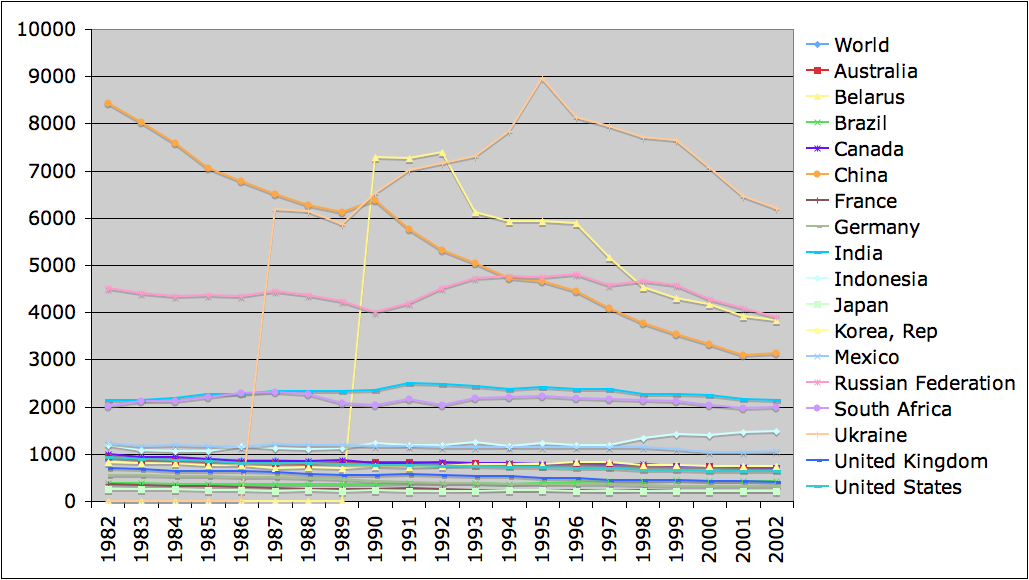
This article claims that the Australians are the worst emitters on the planet, because they emit more CO2 per capita than any other country on the planet. But, surely, a better method of comparison would be seeing how efficient each nation is; that is, comparing nations emissions based upon that country’s economic output, which can be measured by proxy by comparing emissions per $ of GDP. The World Resources Institute has an online database that has just such a measure (and many more). Looking at 2002, the last year available, the least efficient country is Uzbekistan, which throws out 9335.6 metric tons of CO2 per million $ of GDP. By comparison, Australia does less than a 10th of that, 694.7 metric tons per million $, just besting the world average of 706.

Here’s a graph I did comparing the emissions of several countries and the global average for the period 1982-2002:

Metric Tons of CO2 emissions per $1MM GDP
Co2 Emissions Per Gdp $1Mm 1
(click thumbnail for larger version)

When the very inefficient (Ukraine, Russia, Belarus, and China) and relatively inefficient (India, South Africa, Indonesia) countries are excluded, we get this graph:

Metric Tons of CO2 emissions per $1MM GDP
Co2 Emissions Per $1Mm Gdp 2

Consumer spending slows in September
(AP)
:

AP - Consumers, battered by a steep downturn in housing and a severe credit crunch, slowed spending growth in September to the weakest performance in three months.

But in actuality, spending *grew* in September by 0.3%; the *rate* of growth is what dropped, since spending grew by 0.4% in the previous month. The article later mentions that inflation was up only 0.2% for September, that the previous week’s new unemployment claims dropped more than were expected, at that the rate of growth of the economy for the July-September quarter was 3.9%, stronger than expected.

So, lots of good news, and the headline focuses where?