We’ve battened down the hatches, secured all the outdoor items, stocked up on food and bottled water, and have about 30 gallons of fuel for the generator. WIll blog on the other side!
Year: 2008
After reading this piece in the Daily Telegraph claiming prices at the pump were not falling as fast as the price of crude, I decided to see what was going on. I went to the Energy Information Administration website, from which I downloaded the weekly retail gas prices and the spot crude oil prices and compared them to each other. They have records for the latter going back to the beginning of 1986, but for the former only to mid-1990 (with a mysterious gap of 6 weeks between at December 3, 1990 and January 21, 1991). I then charted the price of gas (Weekly U.S. Regular Conventional Retail Gasoline) as a percentage of the price of oil (Weekly Cushing, OK WTI Spot Price FOB):
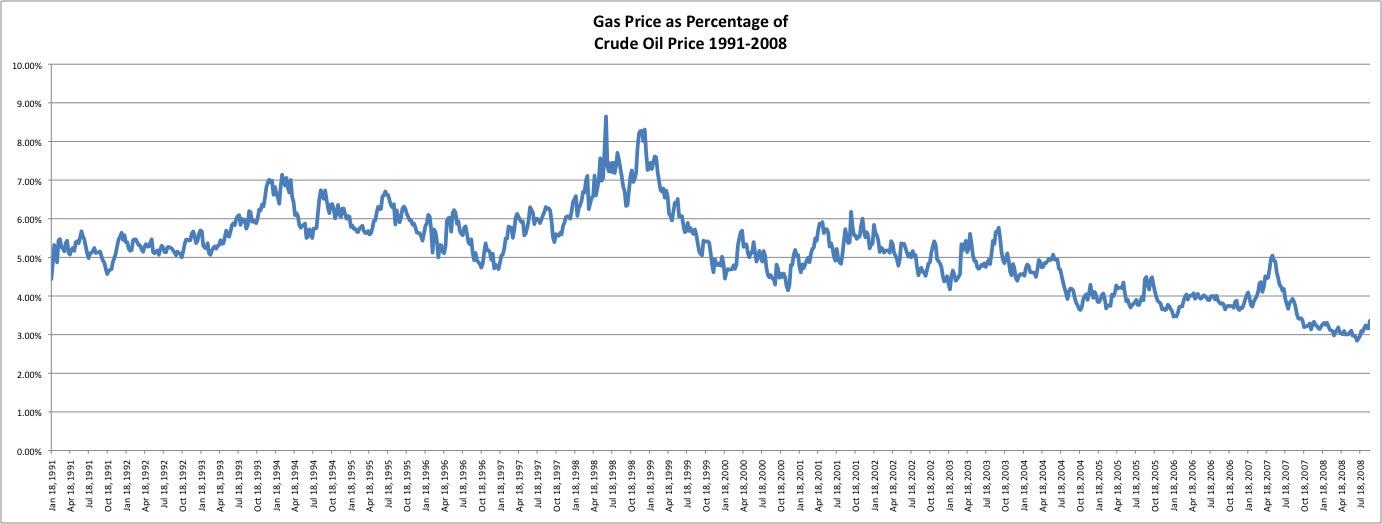
While it is true that the over the last few weeks crude prices have dropped faster than gasoline, gas prices as a percentage of the cost of crude are near the lowest they have been for the dates for which data are available. And when you compare the relative prices:

You can see that historically the prices have been pretty constant, but that crude ran up much more than gasoline, so the price at the pump was actually less than what it would have been had gas moved in lock-step with crude prices.


from the Center for Consumer Freedom (hat tip Reason: Hit and Run):

The U.S. Is Already a Majority-Minority Nation:
The New York Times reports that “ethnic and racial minorities will comprise a majority of the nation’s population in a little more than a generation.” But ethnic and racial minorities already comprise a majority of the nation’s population. The current U.S. population is about 300 million. There are roughly 46 million Hispanic Americans, 40 million African Americans, 35 million Irish Americans, 16 million Italian Americans, 15 million Asian Americans, 10 million Polish Americans, 3 million Greek Americans, and 3 million Russian Americans. That’s a majority right there, and I’ve left out a bunch of ethnic groups.
What the Times really means, of course, is that “Americans who identify themselves as Hispanic, black, Asian, American Indian, Native Hawaiian and Pacific Islander will together outnumber non-Hispanic whites.” We’ve become so accustomed to this arbitrary definition of “ethnic and racial minorities” that it’s easy to lose sight of how bizarre it is. Is there a single objective criterion that unites these particular ethnic and racial minorities while distinguishing them from all the excluded groups? Is there any rational reason why a descendant of Spaniards, say, should count as a real minority, whether or not his ancestors spent time in Latin America, while a descendant of Italians does not? What is it, exactly, that makes Indians more ethnic than Albanians?
While some Americans view the arrival of the milestone heralded by the Times with horror, others see it as a sign of progress. I’d say obsessing about it one way or another indicates a lack of progress.