Methodists object to Richmond Braves

Virginia’s capital has lost the 2012 United Methodist international conference because it is home to a minor league baseball team named the Braves.
[…]
Kenneth Branham, chief of the Monacan Nation, which is based near Lynchburg, Va., told the [Washington] Times that he has no problem with the Richmond Braves. The team’s mascot is a talking duck.

“The mascot thing has been blown out of proportion,” he said. “The problem is not that teams have American Indian names and mascots, but how those mascots act.”

OK, so a private enterprise has a mascot that is ostensibly offensive to Native Americans (even though a Native American representative says it isn’t), and so they are going to move their convention to another city.

THE CITY DIDN’T NAME THE TEAM, PEOPLE! Geez.

When I was growing up, whenever David or I got a cut, a scrape, or a bad sting, our mom would get out the Oil-O-Sol, a reddish-orange, highly viscous liquid that has a smell that, while indescribable, I can recall to this day. I tore a chunk of skin off my hand setting up a computer yesterday, and went to the drugstore on the way home tonight and asked if they carried it. None of the druggists had ever heard of it.

A quick Google search showed lots of hits saying to avoid it in regards to post-op for plastic surgery, and several listings for antique bottles and ads, but only one that had some actual info on it:

I can’t find this stuff for sale anywhere except for perhaps eBay.
But it’s no wonder why these old medicines have died out. This stuff contained Linseed Oil (a known skin irritant), Oil of Turpentine ((Mucous membrane and eye irritant. Harmful if inhaled) , Camphor Oil (also an irritant), Oil of Spearmint, and Eucalptus. Egads!

Still, a bottle of that would have somehow seemed more comforting that the tube of Neosporin I got, even if the latter is more effective.

Oil-O-Sol

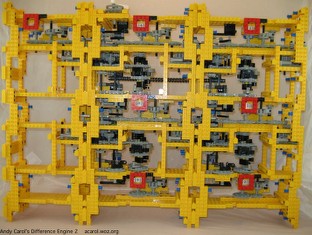
Boing-Boing: Difference Engine mechanical computer made from legos

Cory Doctorow:

An enterprising hacker has created a working “difference engine” — a mechanical calculator first attempted in 19th Century by Charles Babbage — out of legos. The difference engine was immortalized in the William Gibson/Bruce Sterling collaboration of the same name, and it’s a perpetual source of hacker fascination (Ada Lovelace, Lord Byron’s daughter, financed the project and invented the idea of software for it because she was interested in handicapping horse races). Though Babbage was never able to get his design working, London’s science museum did build a Babbage Engine that worked, thanks to the greater precision of twentieth-century machining techniques.

Andy Carol is a Lego builder who created a working Difference Engine in legos, though his machine “only” solves second- and third-order polynomials to three or four digits. The site contains fascinating detail about the workings of Difference Engines and Carol’s implementation thereof.

Link

(Thanks, Rick!)