The Financial White Paper: A Fabulous Tale, by Arnold Kling:

Once upon a time, there was a summer camp. To entertain the kids, the counselors handed out matches1, lighter fluid2, and newspapers3. The camp burned down.

Afterwards, a white paper was written, proposing more supervision by counselors. It called for a systemic counselor to watch out for camp-wide fire hazards, and it called for procedures to put out fires that are “too big to let burn.”

The white paper was written under the direction of two counselors, Larry and Tim, with input from another counselor, Ben.

The end.

1housing policy that encourages speculative purchases and subsidizes mortgage indebtedness
2tax policy that encourages banks and other firms to maximize debt relative to equity
3bank capital regulations that reward securitization and the creation of off-balance sheet entities

Threat Received over Opera
Please support us as we support freedom of expression & human rights

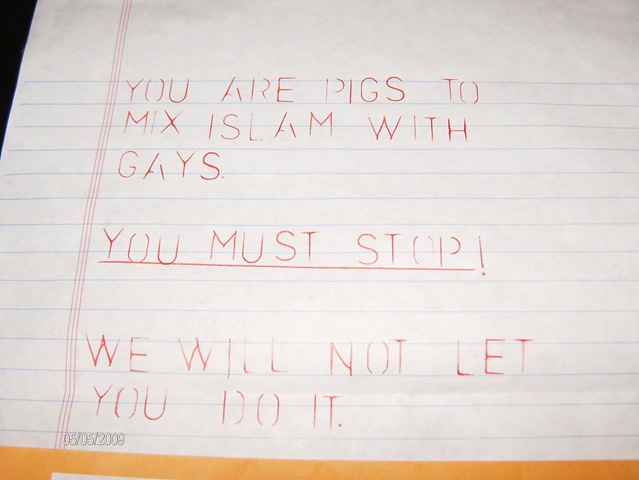
Below is a photo of the threat letter and a press release about it. Please help us spread the word about this, and show your support by buying tickets and donating. For more information, please call (713) 533-9632.
Threat

WINNING WORK AT OPERA FESTIVAL SPARKING CONTROVERSY
‘Edalat Square,’ opening May 21, takes look at Islam, homosexuality

HOUSTON — The organizers of the second annual Opera Vista Festival suspected one of their featured operas would draw controversy. But when an anonymous letter threatening the founders of the Nova Arts Project arrived at founding director Amy Hopper’s doorstep, she realized the show had potential to ignite a firestorm.

“We received this letter that was all about ignorance and hate, and that’s the whole point of this opera — to confront ignorance and hate. It makes it even more important to tell the story,” Hopper said.

The opera is “Edalat Square,” one of two works that won Opera Vista’s inaugural festival competition in 2007 (think “American Idol” for opera composers). Written by Atlanta-based composer R. Timothy Brady, the opera recounts the true story of Mahmoud Asgari, 17, and Ayaz Marhoni, 16, who were hanged in Iran in 2005 for the crime of lavaat, or sex between two men. Brady was inspired by the story to craft a poetic work that offers an unblinking look at bigotry, but is also prayerful and mystical, said Viswa Subbaraman, artistic director and co-founder of Opera Vista.

“It’s an amazing appeal to the soul,” Subbaraman said. “It’s some of the most poignant music and lyrics in opera. I don’t know how you could watch it and not be moved.”

Because of its exploration of two hot-button topics — radical Islam and homosexuality — performances of “Edalat Square” have faced opposition before. At its world premiere at Emory University, the university’s president contemplated canceling the show because of complaints. Some critics have said the show is persecuting the Islamic faith, which festival organizers say it doesn’t. Others object to the homosexual content.

On May 5, Amy Hopper found out the show was already pushing buttons here in Houston. She opened her mailbox to discover a hand-stenciled, anonymous letter that said: “You are pigs to mix Islam with gays. You must stop! We will not let you do it.”

The festival’s organizers actually are glad the opera could spark debate or criticism. That’s part of the purpose of the performing arts — to provoke discussion and ignite the emotions, they said.

“Great art should open a discussion, and I think that’s what this opera does,” Subbaraman said. “Art has never existed in a vacuum — it often has a political bent, and that’s as it should be.”

“Edalat Square” will open the Opera Vista Festival at 8 p.m. Thursday, May 21, in the Wortham Theater Complex at the University of Houston. For more information and a schedule of operas being performed at the festival, visit www.operavista.org or www.novaartsproject.com/shows/ovf.

Nova Arts Project is a Houston-based, not-for-profit performing arts organization that seeks to recreate classics and inspire new works in a fearlessly theatrical way.

Opera Vista is dedicated to continuing the growth of the operatic tradition by producing fully-staged versions of new and contemporary operas, giving living composers a performance venue, and establishing and developing an audience for new opera. Opera Vista is a 501(c)3 nonprofit organization.

Washington Times – LEESON: The benefits of failure :
LEESON: The benefits of failure
Why we should let some firms go belly up

Peter T. Leeson
Friday, April 3, 2009

In a market economy, business deaths are like death itself – an unfortunate but inevitable fact of life. However, recent government bailouts have tried to stop the inevitable by intervening in the market, at least temporarily saving failed firms from the economic grim reaper. Before putting the next failed business on life support, it’s worth remembering why it makes sense to let struggling producers expire.

• When failing businesses are allowed to fail, resources are released from employments where they don’t add value and made available for employments where they do.

Resources used for one purpose can’t be used for another. Thus, it’s important that they find their way to the purposes we value most. Enter the profit-and-loss system. Under this system, when producers use resources in ways that are consistent with our wants, they earn profits. When they don’t, they earn losses. If losses are severe enough or accumulate over time, the producers who earn them go under.

Far from cause for concern, this failure is cause for celebration. When ineffective producers fail, resources committed to producing goods we value less are freed for producing goods we value more. Polaroid’s failure released resources for the production of digital cameras; Commodore Computers’ failure released resources for the production of IBM computers; and Chi Chi’s restaurant’s failure released resources for, well, the production of food that tastes good. Who better to sacrifice the resources required to expand production of the things we want than producers of the things we don’t?

If government prevents failing producers from going out of business, resources get “stuck” in employments where they’re less productive. We can’t have as many of the products we care more about because the means needed to make them remain locked in the manufacture of products we care less about. Society suffers as a result.

• When failing businesses are allowed to fail, producers learn how to combine resources in ways that create wealth.

We take it for granted that producers know what we want. But this information doesn’t appear magically. It has to be produced. The profit-and-loss system produces this information – but only when government lets failing businesses fail.

Profits and losses do for producers what traffic signals do for drivers. They tell them when to “go,” “slow down” and “stop” their productive activities. By communicating which resource combinations consumers value most and which they don’t, profits and losses direct “economic traffic,” informing producers how to produce.

If government prevents ineffective producers from failing, the red light on the “economic traffic signal” stops working. Production continues and resources flow when they should halt, destroying wealth instead of creating it.

• When failing businesses are allowed to fail, producers have incentives to combine resources in ways that create wealth.

The profit-and-loss system works because successful producers reap rewards when they combine resources effectively and unsuccessful producers incur costs when they don’t. The prospect of profits from making good decisions and losses from making bad ones encourages producers to make choices that improve our lives.

But if government shields ineffective producers from the consequences of their bad decisions, producers’ incentives become skewed. For instance, when policy permits producers to enjoy the benefits of successful risk-taking but subsidizes the losses of unsuccessful gambles, producers have an incentive to take on more risk than they should. Since they’re no longer responsible to consumers when they make poor choices, the link connecting producers’ and consumers’ interests is weakened and, with it, the economy’s ability to advance.

At a time when failure is the new dirty word and government seems willing to prop up floundering firms at any cost, we would do well to remember the benefits of letting failing businesses go belly up.

Peter T. Leeson is BB&T Professor for the Study of Capitalism at George Mason University and author of the new book, “The Invisible Hook: The Hidden Economics of Pirates.”.
We Are Very Concerned About the Anger We’re Fomenting, by Matt Welch (Reason: Hit & Run):

I suspect that what the administration might really be worried about is that there’s a glaring contradiction at the intersection of its messaging and policy. Officials talk like they’re really gonna stick it to AIG this time, then they ladle out another $20 billion. You want to punish a banker or a Wall Street executive? Let his company fail. And if he’s broken the law, prosecute him.

“Penny-wise, pound-foolish” comes to mind. But whereas there were 240 pence in the old pound, it is pretty sad that the “penny” of this story – $165 million – is much less than 1/240 of the $85 billion that has been handed to them already, and unfortunately, not likely the last.